
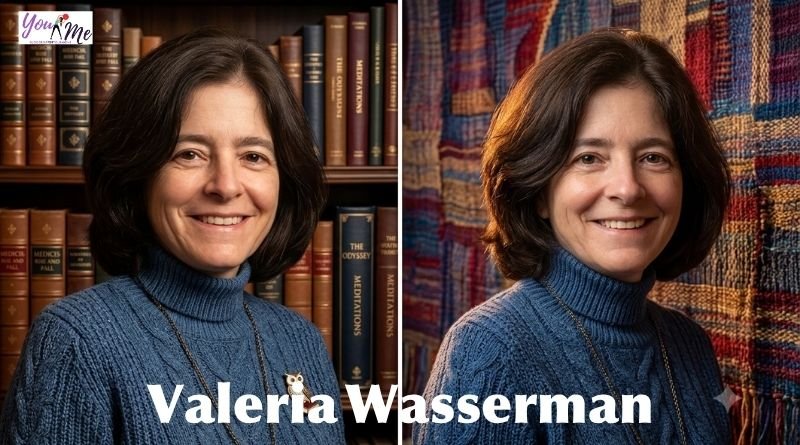
Introduction: Who Is Valeria Wasserman?
Valeria Wasserman is one of those rare individuals. She is a professionally trained Brazilian linguist and translator whose contributions to cross-cultural communication have quietly but powerfully helped some of the most complex intellectual ideas reach readers across continents. Though she is widely recognized today as the wife of Noam Chomsky — arguably the most influential linguist and political thinker of the modern era — Valeria’s own story is one of academic rigor, professional excellence, and deeply principled living. Her journey from the universities of Rio de Janeiro to the global stage of linguistic and cultural translation is a story worth telling in full.
Personal Information Table
| Detail | Information |
| Full Name | Valeria Wasserman Chomsky |
| Year of Birth | 1963 |
| Place of Birth | Brazil |
| Nationality | Brazilian |
| Ethnicity | Brazilian |
| Religion | Not publicly disclosed |
| Education | Law — Universidade Federal Fluminense (UFF); Languages & Linguistics — PUC-Rio |
| Profession | Linguist, Translator, Cultural Consultant |
| Languages Known | Portuguese (Native), English (Fluent) |
| Spouse | Noam Chomsky (married 2014) |
| Stepchildren | Aviva Chomsky, Diane Chomsky, Harry Chomsky |
| Current Residence | São Paulo, Brazil |
| Affiliated Organization | ArtVentures Cultural Projects & Translations |
| Known For | Portuguese–English literary and academic translation |
| Net Worth | Not publicly confirmed |
Early Life and Growing Up in Brazil
Valeria Wasserman was born in 1963 in Brazil, a country known for its rich linguistic diversity, vibrant culture, and deep intellectual traditions. Growing up in this environment, she was naturally drawn to languages from a young age. Brazil’s multilingual social fabric — shaped by Portuguese colonial roots, indigenous languages, African linguistic influences, and waves of European immigration — gave Valeria an instinctive appreciation for how language carries culture, history, and meaning far beyond its words.
Details about her childhood and family background remain largely private, which is very much in keeping with her personality. She has never been one to seek public attention for personal matters. What is clearly established, however, is that she pursued an academic path that reflects both analytical discipline and a love for human expression. She chose to study law at one of Brazil’s most prestigious institutions, the Universidade Federal Fluminense, before pursuing her true calling in linguistics and language studies at the Pontifícia Universidade Católica do Rio de Janeiro, also known as PUC-Rio. This dual academic foundation set her apart from the very beginning of her career.
Academic Background and What It Built in Her
Law at UFF and Linguistics at PUC-Rio
Studying law gave Valeria Wasserman something that most translators do not have — a deeply structured understanding of how language functions in formal, binding, and consequential contexts. Legal language is precise, deliberate, and often high-stakes. Every word matters and every phrase carries weight. This training sharpened her ability to analyze text at a level far beyond casual reading. When she later transitioned to professional translation and linguistics, she brought this legal precision with her, ensuring that her translations were not just linguistically accurate but also contextually and semantically faithful to the original source.
Her decision to then study languages and linguistics at PUC-Rio added the creative, cultural, and communicative dimension to her skill set. Linguistics as an academic discipline involves studying how language is structured, how it changes over time, how it varies across communities, and how meaning is created and transmitted between people. For someone who would go on to translate some of the most complex academic and political writing in the world, this foundation was absolutely essential.
The Combination That Makes Her Unique
Very few professional translators hold both a legal degree and a formal background in linguistics. This combination gave Valeria Wasserman a genuinely rare professional profile. She could handle academic texts with intellectual depth, legal documents with structural accuracy, and literary works with emotional sensitivity — all of which are very different challenges in translation. This versatility became one of the defining features of her professional reputation.
Professional Career and the Work She Has Done
Early Career in Finance and Law
Before fully committing to translation and linguistics, Valeria Wasserman worked in Brazil’s financial and legal sectors. She served as an investment analyst and a legal assistant at various points in her early professional life. These roles gave her practical experience in how language functions in business and legal environments — experience that would prove invaluable later when translating documents that crossed both cultural and professional boundaries.
Moving Into Translation
Her transition into translation was a natural progression rather than an abrupt change. She had the academic training, the analytical mindset, and the cultural sensitivity needed to succeed in this field. As she developed her translation practice, she focused primarily on Portuguese–English projects, bridging two of the world’s most widely spoken languages. Her work brought English-language ideas to Portuguese-speaking audiences and vice versa, contributing to an ongoing global exchange of knowledge and culture.
ArtVentures Cultural Projects and Translations
Valeria Wasserman is professionally associated with ArtVentures Cultural Projects and Translations, an organization dedicated to literary translation, cultural exchange, and the promotion of cross-border intellectual dialogue. Through this organization, she has worked on projects that span literature, academia, politics, and the arts. Her work here reflects her belief that translation is not a mechanical process but a creative and ethical act — one that requires the translator to deeply understand both the source and target cultures before putting a single word on the page.
Her approach to translation has always prioritized what might be called cultural fidelity — the idea that a good translation preserves not just the meaning of words but the tone, the cultural references, the emotional register, and the intellectual intent of the original author. This philosophy aligns closely with the highest standards of the translation profession and has earned her significant respect among peers and clients alike.
Marriage to Noam Chomsky and What It Represents
How They Met and When They Married
Valeria Wasserman and Noam Chomsky married in 2014, following the death of Chomsky’s first wife, Carol Doris Schatz, who passed away in 2008 after a long illness. The details of how Valeria and Chomsky met have not been made widely public, which again reflects their shared preference for privacy. What is clear is that they share a profound intellectual and personal bond — two people who have built their lives around language, meaning, and the pursuit of understanding.
Their marriage brought Valeria into one of the most intellectually prominent families in modern academic history. Noam Chomsky is a figure whose work in linguistics transformed the field and whose political writing has influenced generations of thinkers, activists, and policymakers around the world. Marrying someone of that stature would overwhelm many people. For Valeria, it appears to have been a natural partnership — two professionals who respect each other’s expertise and support each other’s work.
Life Together in São Paulo
The couple currently resides in São Paulo, Brazil — a city that suits Valeria’s roots and provides Chomsky with a base outside of the United States where he can continue his work in a quieter environment. São Paulo is Brazil’s intellectual and cultural capital, home to world-class universities, vibrant arts scenes, and a deeply engaged intellectual community. For two people who have dedicated their lives to ideas, language, and cross-cultural understanding, it is a fitting home.
Standing Firm During a Public Crisis
One of the moments that brought Valeria Wasserman into the public eye more directly came in 2023 and 2024, when Noam Chomsky suffered serious health challenges. Following a stroke, false reports began circulating on social media claiming that Chomsky had died. It was Valeria who stepped forward publicly and clearly to correct the record, confirming that her husband was alive and continuing to recover. Her handling of this situation — calm, direct, dignified, and firm — demonstrated the qualities that define her character both personally and professionally. She did not collapse under the pressure of public scrutiny, and she did not allow misinformation to go unchallenged. She simply told the truth and stood by her husband.
Lifestyle, Values, and Personal Philosophy
A Life Centered on Purpose Over Fame
One of the most striking things about Valeria Wasserman is her consistent and deliberate choice to live a life of substance rather than celebrity. In an era where public attention is treated as currency and social media followings are used as measures of professional success, she has chosen a different path entirely. She does not maintain a public social media presence, she does not seek media appearances, and she does not use her marriage to Chomsky as a platform for self-promotion. This is not accidental — it is a reflection of deeply held values about what truly matters.
Her lifestyle is shaped by intellectual engagement, professional commitment, and personal integrity. She reads widely, works carefully, and lives deliberately. Those who have interacted with her professionally describe her as someone who listens before she speaks, thinks before she acts, and takes her responsibilities as a communicator seriously at every level.
What She Believes About Language and Translation
Valeria’s professional philosophy is closely tied to her personal values. She sees translation not as a technical service but as a form of cultural stewardship. When a translator takes on a text, they are taking responsibility for how that text will be understood by readers who may have no access to the original. A careless translation can distort meaning, strip out cultural nuance, and ultimately mislead the reader. A careful and skilled translation, by contrast, opens doors — it allows ideas to travel across borders without losing their essential character.
This philosophy has guided her work throughout her career, and it is reflected in the quality and reputation of the projects she has been associated with. For someone whose professional partner is the man who revolutionized the scientific study of language itself, this commitment to linguistic integrity carries additional meaning.
Valeria Wasserman’s Role in Chomsky’s Broader Legacy
More Than a Spouse
It would be a disservice to reduce Valeria Wasserman’s role in Noam Chomsky’s life to that of a supportive partner. She is a linguist herself, trained in the very field that made Chomsky famous. She understands his work at a technical and intellectual level that only a genuine expert can. Her support for his ongoing projects — particularly in his later years when health challenges have limited his mobility and energy — is informed by that understanding. She is not simply a caregiver; she is a collaborator in the broad sense of someone who shares a life mission with the person she has chosen to share her life with.
Helping Chomsky’s Ideas Reach Brazil and Beyond
Brazil is one of the countries where Chomsky’s political and linguistic writings have had a profound impact. The Brazilian intellectual and political left has long engaged with his critiques of American foreign policy, his analysis of media and power, and his foundational work in generative grammar. Valeria’s presence in his life — and her work as a Portuguese–English translator — has certainly helped deepen the channels through which his ideas reach Brazilian and broader Lusophone audiences. While the full extent of her specific translational contributions to his work is not exhaustively documented in public records, the alignment of her professional expertise with his intellectual output speaks for itself.
Why Valeria Wasserman’s Story Matters
The story of Valeria Wasserman matters for several reasons that go beyond biographical interest. First, it is a story about the value of language professionals — a class of experts whose work is often invisible precisely because it is done well. When a reader in São Paulo picks up a translation of a Chomsky essay and finds it clear, compelling, and intellectually faithful to the original, they rarely stop to think about the translator who made that experience possible. Valeria’s career is a reminder that translation is skilled, demanding, and deeply consequential work.
Second, her story is a reminder that intellectual greatness can take many forms. Valeria is not a household name in the way that Chomsky is, but her contributions to the world of ideas — through her translations, her cultural work, and her support of one of history’s greatest thinkers — are real and lasting. She represents the kind of quiet excellence that holds up a great deal of what we think of as civilization: careful, skilled, principled work done without expectation of applause.
Third, her story is an inspiring one for anyone building a professional life in the humanities. In a world that increasingly values STEM skills above all others, Valeria’s career is evidence that linguistic expertise, cultural sensitivity, and communicative skill are genuinely powerful tools — professionally, intellectually, and personally.
Conclusion
Valeria Wasserman is many things: a trained lawyer, a professional linguist, a skilled translator, a cultural bridge-builder, a devoted partner, and a woman of extraordinary intellectual and personal substance. Her life has been shaped by a commitment to precision, empathy, and the belief that language — when treated with care and respect — can change how people understand each other and the world they share. As someone who has worked to carry ideas across linguistic and cultural borders for decades, she has contributed quietly and meaningfully to the global conversation that defines our time. And as the partner of Noam Chomsky, she has stood beside one of the most important intellectual figures of the twentieth and twenty-first centuries — not in his shadow, but as an equal in purpose and in principle.
Frequently Asked Questions About Valeria Wasserman
Q1: Who is Valeria Wasserman?
She is a Brazilian linguist and translator married to world-renowned philosopher Noam Chomsky.
Q2: When did Valeria Wasserman marry Noam Chomsky?
She married Noam Chomsky in 2014.
Q3: Where is Valeria Wasserman from?
She is from Brazil, born in 1963.
Q4: What does Valeria Wasserman do professionally?
She works as a professional Portuguese–English translator and linguist.
Q5: Where does Valeria Wasserman live now?
She currently lives in São Paulo, Brazil with her husband Noam Chomsky.
Q6: What university did Valeria Wasserman attend?
She studied Law at UFF and Linguistics at PUC-Rio in Brazil.
Read also related: Duoisgreatforyouandme